Stale Rankings: Checking a Used Miner's Numbers
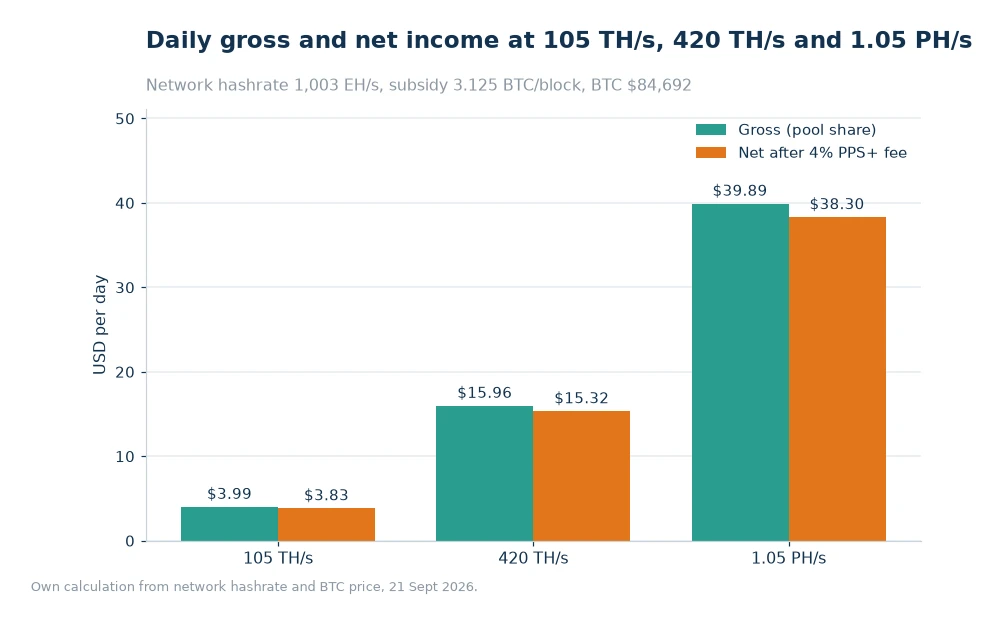
A used 105 TH/s unit priced off last quarter's ranking can look like a bargain and still lose money at your wall socket. At a $0.06 tariff the machine settles $3.83 a day after the listed charge; at 22 joules per terahash its power costs $3.33 and leaves 50 cents, while at 30 joules the bill is $4.54 and the day ends 71 cents short. The number that matters is not the asking price but the efficiency after a few years of dust.

Key takeaways
- 105 TH/s settles $3.83 a day, and 420 TH/s settles $15.32 on the same basis.
- At 22 J/TH the power bill is $3.33 a day, leaving $0.50; at 26 J/TH it leaves about a dime less than nothing.
- A ranking row is only valid for the difficulty and price it was generated with, which can be two weeks old.
- Used units lose efficiency to dust and worn fans, so measure the draw rather than trusting the label.
The ranking shows today, the listing shows yesterday
A ViaBTC Miner Ranking row is often the only reference a buyer has, so it is worth understanding what the row does and does not contain. Second-hand listings quote a model number and a price. The model number leads to a spec sheet, and the spec sheet leads to a ranking row, and somewhere in that chain the assumption is made that all three describe the same machine at the same moment. They do not. The spec sheet is a factory figure, the ranking row is a snapshot of current network conditions, and the physical unit may have been running for three years in a shed.
A buyer who checks the ranking once and stops has effectively decided that difficulty will not move and that the unit performs as new. Both assumptions are false on a long enough timeline, and the second is often false on the day of delivery.
Three inputs that move while a unit sits unsold
Difficulty is the first and the fastest. It recalculates roughly every two weeks, and a unit listed in spring may be priced against a network that has since absorbed several percent more hashrate. The next estimate read −2.12% on 21 Sept 2026, a small easing, but the point stands: the row is a snapshot.
The coin price is the second. It moves continuously, and a listing that looked marginal at one price can look comfortable at another. That is not a reason to buy, because the price can move back just as quickly; it is a reason to state the price assumption in your own calculation so you know what you are relying on.
The listing date is a fourth clue, because a unit priced months ago carries assumptions that have since expired.
Efficiency is the third, and the one the seller controls least. Dust on a heatsink, a fan running at reduced speed, a thermal paste that has dried out: each raises the joules per terahash, and each is invisible in the listing. A unit rated at 22 J/TH when new may measure 26 after three summers, and the difference at 105 TH/s is about $0.60 a day, which is more than the entire margin at the lower figure.
Repricing the unit at your tariff
The ranking cannot know your tariff, and the difference between industrial and residential power is larger than the difference between most machine models. A unit that ranks comfortably at $0.04 per kWh can be underwater at $0.10. Before agreeing a price, substitute your own rate into the calculation and see whether the unit still clears its power bill with something left for maintenance.
There is a second substitution worth making: your ambient temperature. A machine in a warm room throttles, and a throttled machine produces fewer shares for the same watts, which is the same as a worse efficiency. The ranking's rows assume a bench, not a cupboard.
Then there is provenance. A unit from a farm that ran it at 60% fan speed in a filtered hall has lived a different life from one that ran flat out in a container. Neither seller will say so, and both will quote the same model number. The only reliable correction is the meter reading, plus a look at the heatsink fins and the fan bearings.
Finally, consider what a spare part costs and how long it takes to arrive. A used unit with a discontinued controller can become a paperweight for a month over a part that costs a few dollars, and a month offline at 105 TH/s is about $115 of credit at current rates. That risk is not in the ranking either, and it is the one most likely to turn a marginal purchase into a loss.
A used 105 TH/s unit at three efficiencies
The table holds hashrate and tariff constant and varies only the measured efficiency, which is what a buyer should establish before paying. The settled credit is $3.83, taken from the chart.
| Measured efficiency | Wall power | Power per day | Margin per day | Decision |
|---|---|---|---|---|
| 22 J/TH | 2,310 W | $3.33 | +$0.50 | Worth a second look |
| 26 J/TH | 2,730 W | $3.93 | −$0.10 | Only at a lower price |
| 30 J/TH | 3,150 W | $4.54 | −$0.71 | Walk away |
The middle row is the quiet killer. Ten cents a day is small enough to ignore in a spreadsheet and large enough that the machine is very unlikely to repay its purchase price. If the asking price is low precisely because the unit sits in that band, the discount is not a discount; it is the market pricing the inefficiency correctly.
Worked example
Take the 105 TH/s unit and price it as though the seller's efficiency claim were true, then as though it were four joules worse.
- Terahash rate: 450 ÷ 1,003,000,000 = 0.00000044865 BTC per day.
- 105 TH/s: 105 × 0.00000044865 = 0.00004711 BTC, shown as 4.71e-05.
- Gross: 0.00004710 × 84,692 = $3.99.
- Listed charge: 3.99 × 0.04 = $0.16, leaving $3.83.
- Best case at 22 J/TH: 105 × 22 = 2,310 W; 55.44 kWh; × 0.06 = $3.33; margin $0.50.
- Measured case at 26 J/TH: 105 × 26 = 2,730 W; 65.52 kWh; × 0.06 = $3.93; margin −$0.10.
- Worst case at 30 J/TH: 105 × 30 = 3,150 W; 75.6 kWh; × 0.06 = $4.54; margin −$0.71.
- The four-joule gap is worth $0.60 a day, or about $18 a month, which is the amount the purchase price should be reduced by if the unit cannot be cleaned back to its rated efficiency.
Frequently asked questions
How do I check a used miner's real efficiency?
Put a meter on the wall feed and read the power while the unit is hashing at its stable rate, then divide watts by terahashes; a 105 TH/s unit at 2,730 W is 26 J/TH, which is already past break-even at $0.06 per kWh.
Is an old ranking still useful for a used purchase?
Only as a starting point: it tells you where the model stood when the page was generated, and you still need to apply current difficulty, the current coin price and your own tariff before the row means anything.
What efficiency should I look for at 105 TH/s?
At $0.06 per kWh and a $3.83 settled credit, anything below about 25 J/TH leaves a positive daily margin; above that the power bill overtakes the credit and the purchase needs a much lower price to make sense.
Verify the serial, then verify the arithmetic
Ask for the serial, the firmware version and a photo of the dashboard under load, then meter the unit yourself if the seller will allow it. The Profit Calculator turns your measured hashrate into a daily figure you can compare with the seller's claim, and the fee schedule fixes the deduction that figure still has to absorb. A used machine is only a bargain if its measured efficiency clears your tariff, and that is a fact about the unit, not about the listing.
Sources: ViaBTC ranking, calculator and pricing pages[1]. Inputs read 21 Sept 2026: 132.76 T difficulty, 1,003 EH/s, 3.125 BTC subsidy, 144 blocks a day, $84,692 per BTC, with the next estimate at −2.12%. Published 24 Oct 2026; efficiency and tariff values in the table are examples.