Reading a Cable Quotation Line by Line
A cable quotation is a short document with long consequences, because the model name, the cross-section, the colour and the standard on each line decide what actually arrives at the gate. KUKA CABLE publishes the figures those lines can be checked against, from 4 mm² at 56 strands of 0.29 mm and 5.5 mm overall through 6 mm² at 84 strands and 6.0 mm to 10 mm² at 142 strands and 7.5 mm.

Key takeaways
- Every quotation line can be tied to a published value: 5.5 mm diameter for 4 mm², 6.0 mm for 6 mm² and 7.5 mm for 10 mm², with 59 g, 78 g and 130 g per metre beside them.
- The model name deserves a standard: TUV 2PfG 1169/08.2007, EN 50618:2014 and IEC 62930 are the three the manufacturer names for the PV family.
- Voltage and proof tests belong on the line as well, since the published figures are DC 1.8/1.8 kV rated, 6.5 kV AC at 50 Hz for five minutes on the finished cable and a 10 kV spark test in production.
- Unit price, minimum quantity, lead time and warranty wording appear nowhere on the manufacturer's site, so those lines can only be compared once they are written into a quotation.
Line one: the model, the colour and the standard
Model names in this family are not decoration. Published models include H1Z2Z2-K solar cable, PV1-F solar cable, a UL 4703 solar PV wire, a 1500 V solar cable, TUV solar cable in 4 mm² and 6 mm², and a twin-core version. The solar cable range groups those models on one page, which makes the model list the natural place to start reading a quotation. Two quotations can both read solar cable and describe entirely different constructions, so the model belongs on the line before the quantity does.
Colour follows the model: black or red for the 1500 V construction described on the manufacturer's own page. Core count belongs here as well, because a twin-core order and a single-core order carry the same cross-section figure and a different number of conductors.
The standard is the third item that has to appear in the same place. The manufacturer names TUV 2PfG 1169/08.2007, EN 50618:2014 and IEC 62930 for the PV family, and lists TUV EN 50618, PV1-F, UL 4703 and IEC 62930 as the common international certifications for PV cable. A line that says only certified leaves the buyer to guess which of those it means.
Line two: cross-section and stranding
Cross-section on its own is ambiguous, which is why the published table always pairs it with a stranding. The smaller sizes use 0.25 mm wire, with 1.5 mm² built from 39 strands and 2.5 mm² from 49; from 4 mm² upward the wire is 0.29 mm, with 56 strands, 84 strands and 142 strands for 4 mm², 6 mm² and 10 mm².
That pattern is the fastest way to check whether a quotation is for the product family you think it is. A quoted 6 mm² conductor made from a different strand count, or from solid wire, is a different cable with a different bend behaviour, however similar the square millimetre figure looks.
The conductor is also tinned and flexible, class 5 to IEC 60228, on the published construction. Tinning matters at the termination end, where the joint between copper and the surrounding air is the place corrosion would begin.
Line three: diameter, weight and the drum
Diameter is the line a connector and a gland are chosen from, and it moves far more slowly than the cross-section: 5.5 mm at 4 mm², 6.0 mm at 6 mm² and 7.5 mm at 10 mm². Half a millimetre is the entire difference between two neighbouring sizes, so a quotation that omits the diameter leaves a fitting decision unresolved.
Weight is the line that reveals whether the length on the order is plausible. Published weights are 59 g per metre for 4 mm², 78 g for 6 mm² and 130 g for 10 mm², which by my own multiplication make a 100 m length 5.9 kg, 7.8 kg and 13.0 kg respectively. Those figures cover cable only, and a packed drum adds its own weight on top.
Read the length and the weight together and two useful questions appear. Is the quoted length per drum or in total, and does the packing list that accompanies it look like the same number of metres the price line charges for.
Line four: voltage, proof tests and paperwork
The electrical line should carry the rated voltage and the proof tests that go with the construction. On the 1500 V solar cable page the published values are DC 1.8/1.8 kV rated, a test voltage of 6.5 kV AC at 50 Hz for five minutes on the finished cable, and a 10 kV spark test during production. A quotation that shows only a rated voltage is missing the two tests that prove the delivered cable rather than the material that went into it.
Thermal limits belong here too, since they describe the same purchase: ambient −40 °C to +90 °C, short-circuit +120 °C for 20,000 hours and +250 °C for 5 seconds, tensile strength before ageing of at least 8 N/mm² and elongation before ageing of at least 125%.
Paperwork closes the line. The certificates page counts more than 30 certificate types, names TUV, IEC, CE, SAA and UL among them and describes the UL entry as being in the process of updating, so a quotation should say which certificate accompanies the shipment rather than which certificates the company holds.
Line five: what the quotation still has to answer
Anyone searching for a solar cable price on the manufacturer's site finds the cross-section table and not a currency amount. Unit prices, minimum order quantities, lead times, shipping costs and warranty terms are absent from the published pages, which means a quotation is the first and only place those five items can be compared.
The published pages do carry what surrounds them. A free sample is offered, data sheets and a catalogue can be downloaded, a logistics page and a customised services page exist, and a product consultant is described as following an enquiry from specification through delivery under a one-stop butler service.
Two further details are worth putting to a supplier on the same sheet: which of the published warehouse locations would serve the project, and which contact channel will carry the order confirmation, since the phone number and the email address are printed on every page of the site.
| Line on the quotation | Published value to check against | Where it comes from |
|---|---|---|
| Model name and standard | H1Z2Z2-K, PV1-F, UL 4703, 1500 V; TUV 2PfG 1169/08.2007, EN 50618:2014, IEC 62930 | Product pages and certificates page |
| Cross-section and stranding | 4 mm² as 56 × 0.29 mm, 6 mm² as 84 × 0.29 mm, 10 mm² as 142 × 0.29 mm | Cross-section table |
| Overall diameter | 5.5 mm, 6.0 mm and 7.5 mm for the three sizes above | Cross-section table |
| Weight per metre | 59 g, 78 g and 130 g per metre | Cross-section table |
| Voltage and proof tests | DC 1.8/1.8 kV, 6.5 kV AC for five minutes, 10 kV spark test | 1500 V solar cable page |
| Thermal limits | −40 °C to +90 °C ambient, +120 °C for 20,000 h, +250 °C for 5 s | 1500 V solar cable page |
Worked example: three checks on one line
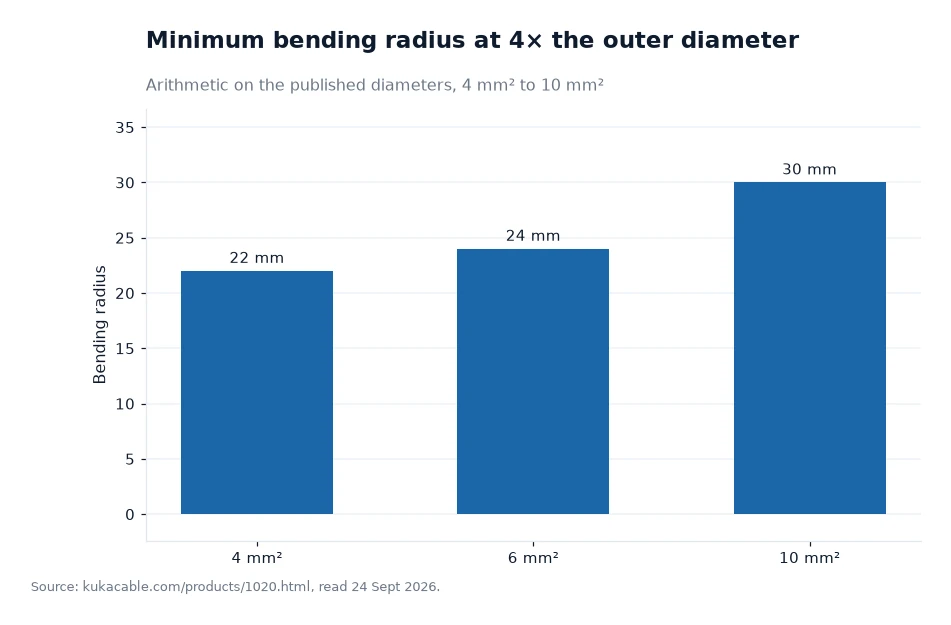
Take a line that reads 1500 V solar cable, 6 mm², black, 500 m. First check the diameter: the published figure is 6.0 mm, so the minimum bending radius is 24 mm by my own arithmetic on the four times rule, and any gland or clip on the project has to accept that diameter.
Second check the weight. At 78 g per metre a 500 m order comes to 39 kg of cable by my own multiplication, before the drum is counted, so a packing list that reports substantially less deserves a question. Third check the stranding: 84 strands of 0.29 mm is the published construction for 6 mm², and anything else on the line is a different product under the same size label.
The three checks need no laboratory and no tool beyond a datasheet. What they cannot do is confirm ageing, moisture or flame behaviour, and those are the properties the test reports exist to cover, which is why the paperwork line is part of the quotation rather than an afterthought.
Frequently asked questions
Why is no price published for the cable?
The manufacturer's site publishes the cross-section table, the mechanical and electrical values and its certificate list, but no unit price, minimum order quantity or lead time. Those figures depend on the construction, the quantity and the destination, so they are answered on a quotation instead. Ask for the price basis and the quantity it applies to in the same message.
Which published values will catch a quotation error fastest?
Three: the overall diameter, the weight per metre and the stranding. The published figures are 5.5 mm and 59 g per metre with 56 strands of 0.29 mm for 4 mm², 6.0 mm and 78 g with 84 strands for 6 mm², and 7.5 mm and 130 g with 142 strands for 10 mm². A line that disagrees with those numbers is either a different construction or a typographical error.
How to close the loop
Send the supplier your own reading of each line, with the published value beside it and a question where the two differ. That turns a quotation into a checklist both sides can sign, which is cheaper than discovering a diameter mismatch after the connectors have been delivered.
The manufacturer's own service description supports that way of working: a product consultant is named as responsible for the enquiry, the delivery and the after-sales maintenance of an order, and the site offers free samples, downloadable data sheets and a catalogue for exactly this comparison. What it does not offer is a published price list, so the loop closes with a written quotation.
Sourcing: the numbers behind this line-by-line reading of a quotation are the manufacturer's own published figures, gathered from its website 24 Sept 2026[1].